Fintech / Agentic Sales Operations, 2026
The trust layer for an agentic sales system
A large financial services company was changing how it ran outbound sales. Instead of a team of business development reps working accounts by hand, a set of AI agents would do most of the work in the background, sending renewal follow-ups, drafting cross-sell briefs, recommending pricing, and moving leads through sequences. Sellers would supervise rather than execute. I came in as the AI experience flow designer, embedded with product and engineering for a quarter, to design the interfaces that made that supervision possible.
A note on this case study: this was built for a large financial institution, on internal tooling, with data that is proprietary and confidential. I can't name the client, show unmodified production screens, or reproduce real numbers. What's described here is true to the design problem and the decisions made. The screens use sample data and have identifying details removed.
Two problems sat underneath the project, and they turned out to be the same problem at different altitudes.
The first was trust at the desk. If an agent sends a renewal follow-up to twelve accounts while you're in a meeting, you need to see that it happened, understand why the agent decided to do it, and catch it if it was wrong, without drowning in notifications for the ninety percent of actions that were fine. Sellers are personally accountable for these relationships. A system that acts on their behalf without showing its work is not a system they will use.
The second was trust at the top. Leadership had no reliable view of whether the outbound motion was working at all. The numbers that mattered, nurture engagement, how many leads got worked, how many meetings got booked, how much pipeline got handed to sales, were spread across four systems, and some of the connections between those systems were broken or not built yet. You can't tell whether the agents are performing if you can't trust the data they're measured against.
The seller's home: exceptions, not a feed
The main screen a seller opens is built around an Exception Queue. The agent is working autonomously in the background. The screen's job is to surface only the accounts that need a human, and to make the reason legible. “Activity suggests this could be a warm lead, but recent changes may mean the data is unreliable” is a different prompt than “this lead may be cold,” and each one carries a different recommended action: follow up, deprioritize, hand off, or scrub.
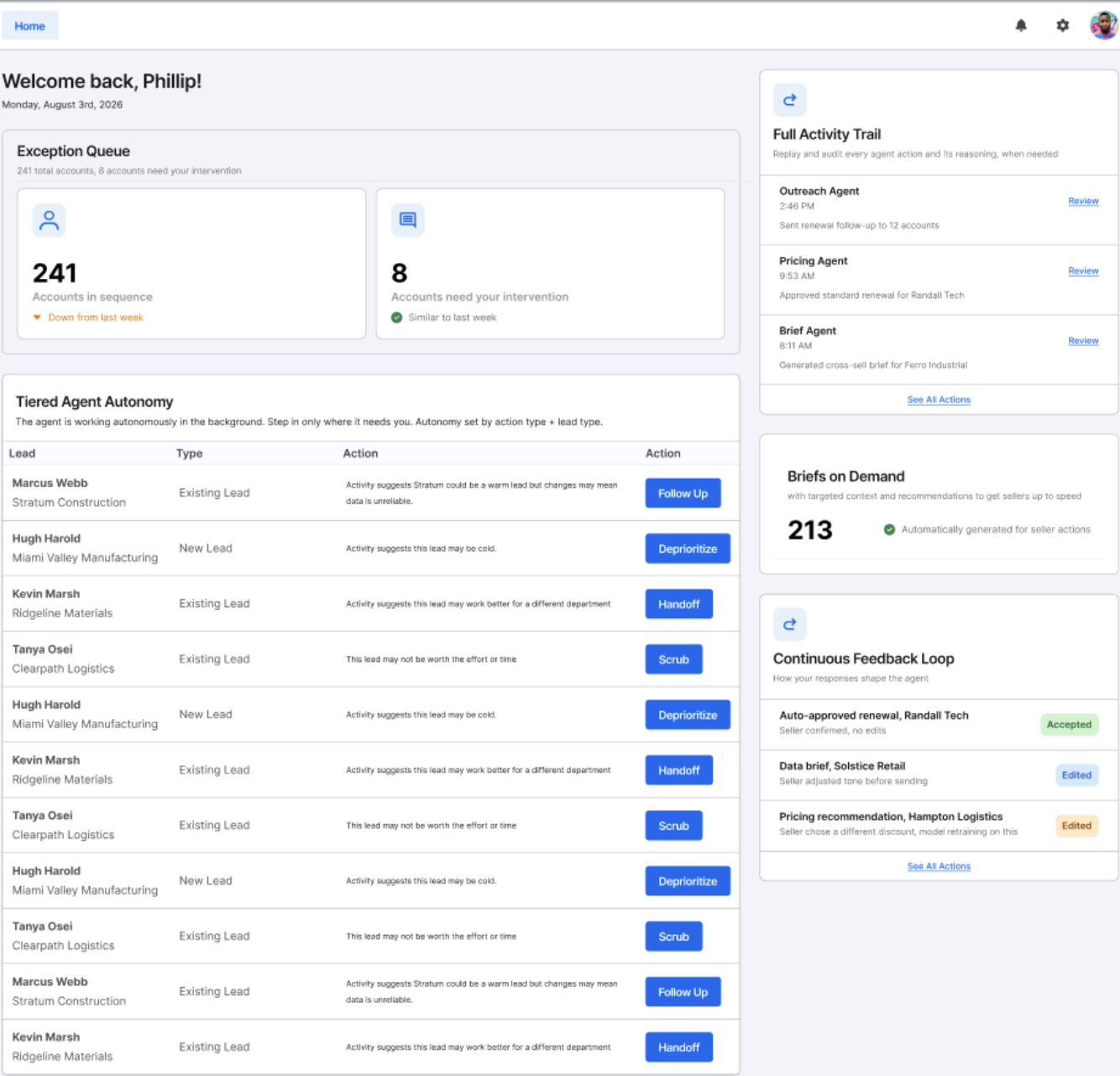
Autonomy is set by the seller, not fixed by the system. You decide what an agent is allowed to do without asking, broken down by action type and by lead type. A seller who trusts the agent on existing-lead follow-ups but wants to review every new-lead pricing recommendation can say exactly that.
Every agent action lands in a Full Activity Trail you can replay and audit, including the reasoning behind each decision. And a Continuous Feedback Loop shows how your responses shape the agent over time. When you accept a recommendation without edits, when you adjust the tone of a brief before it sends, when you override a pricing suggestion, the screen shows that the model is learning from it. The loop is visible on purpose. A seller who can watch their corrections changing the system is a seller who keeps correcting it.
The decision under all of this was to never present a confident action on top of shaky data. Where the signal is uncertain, the recommendation says so, in plain language, instead of rendering the same way a high-confidence call would.
The leadership view: a funnel with a readiness status
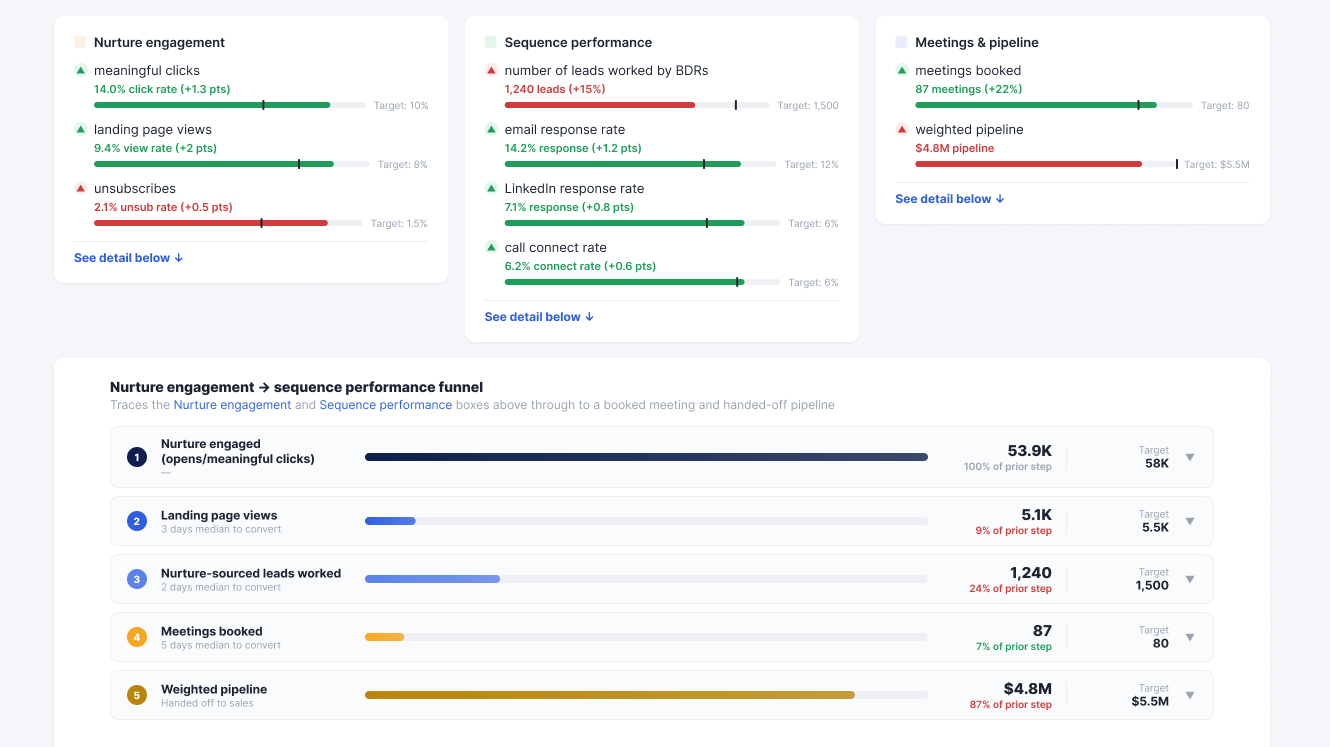
The Outbound Performance Dashboard traces the whole motion as one funnel: nurture engaged, then landing page views, then nurture-sourced leads worked, then meetings booked, then weighted pipeline handed to sales. Each stage carries its conversion rate to the next step, its median time to convert, and its target, so a leader can tell at a glance whether a shortfall is a volume problem, a conversion problem, or a speed problem.
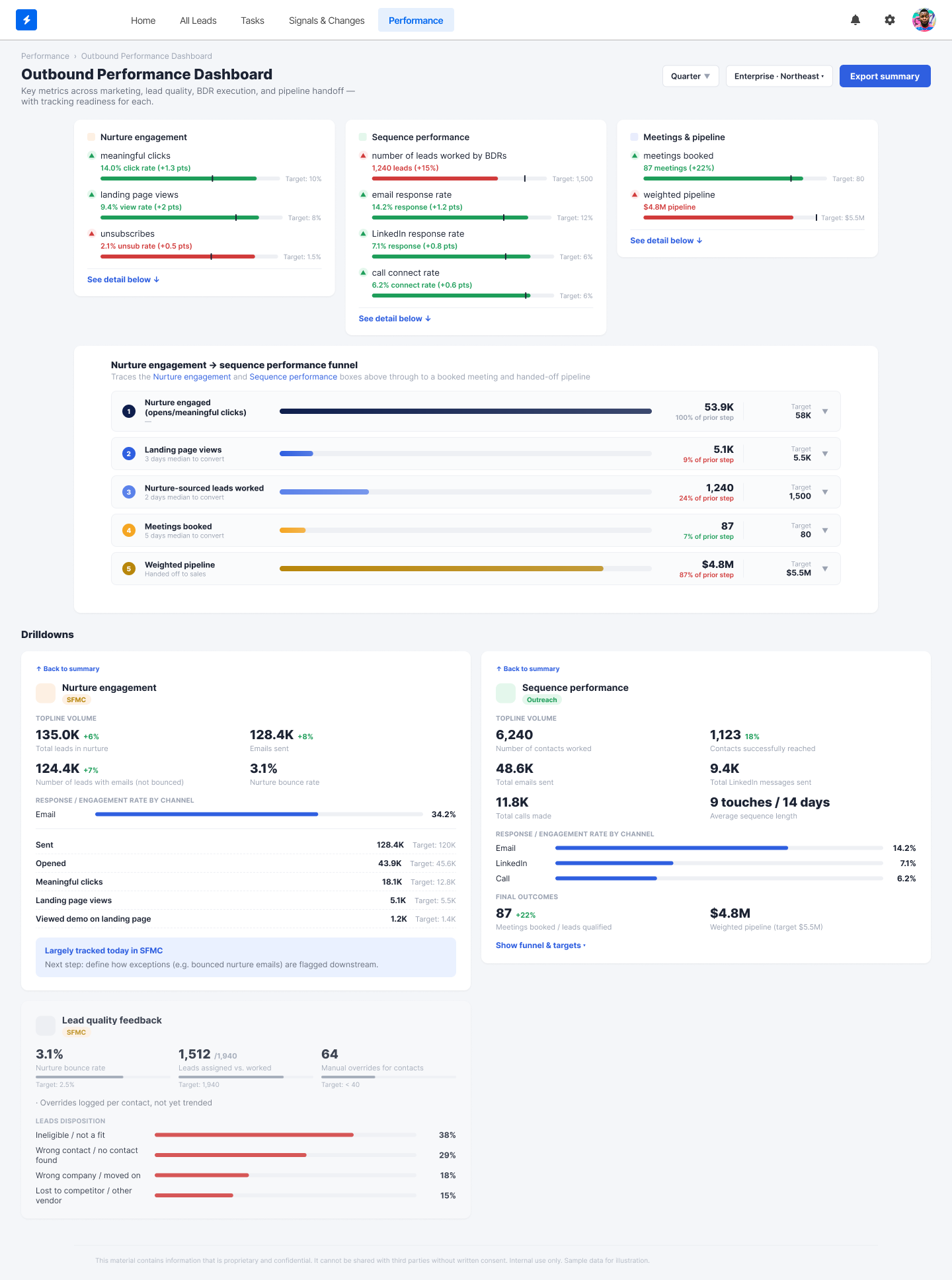
The part I care most about is what we called tracking readiness. Every metric on the dashboard carries a status for whether the data behind it can actually be trusted yet. A drilldown doesn't just show a number. It names the source system the number came from and flags what's still broken. “Largely tracked today. Next step: define how bounced nurture emails are flagged downstream.” That turned “we can't measure this yet” from a silent gap into a visible, assignable piece of work.
This mattered because the alternative is worse. A dashboard that shows every metric with the same authority, including the ones built on half-connected pipelines, teaches leadership to make confident decisions on unreliable inputs. Marking the soft spots keeps the dashboard honest while the plumbing gets fixed.
One idea at two altitudes
The seller's screen and the leadership dashboard are the same principle applied twice: make the machine's confidence, its actions, and its blind spots legible to the person who's accountable for the outcome. An agent that hides its reasoning and a dashboard that hides its data gaps fail the same way. They ask a human to stand behind a result they weren't allowed to inspect.
The system shipped over the quarter. After it launched, the team had visibility it didn't have before: where the funnel was actually leaking, which agent actions sellers trusted and which they consistently overrode, and which metrics still couldn't be relied on. The overrides in particular became their own signal, a running list of where the agents and the data still needed work.
What I learned
Designing for an agentic system is mostly disclosure design. The hard interface questions aren't about the agent's output. They're about how you show what it did, how sure it was, where it got its information, and how a person takes back control. Those are the same questions I work on in regulated products generally. An adverse-action notice and an agent's reasoning trail are closer than they look. The stakes just move from “a customer needs to understand a decision” to “a seller needs to stand behind one.”
Have a project that needs to hold up under real scrutiny?
Let's talk about what you're building and whether UXcalibur is the right fit.